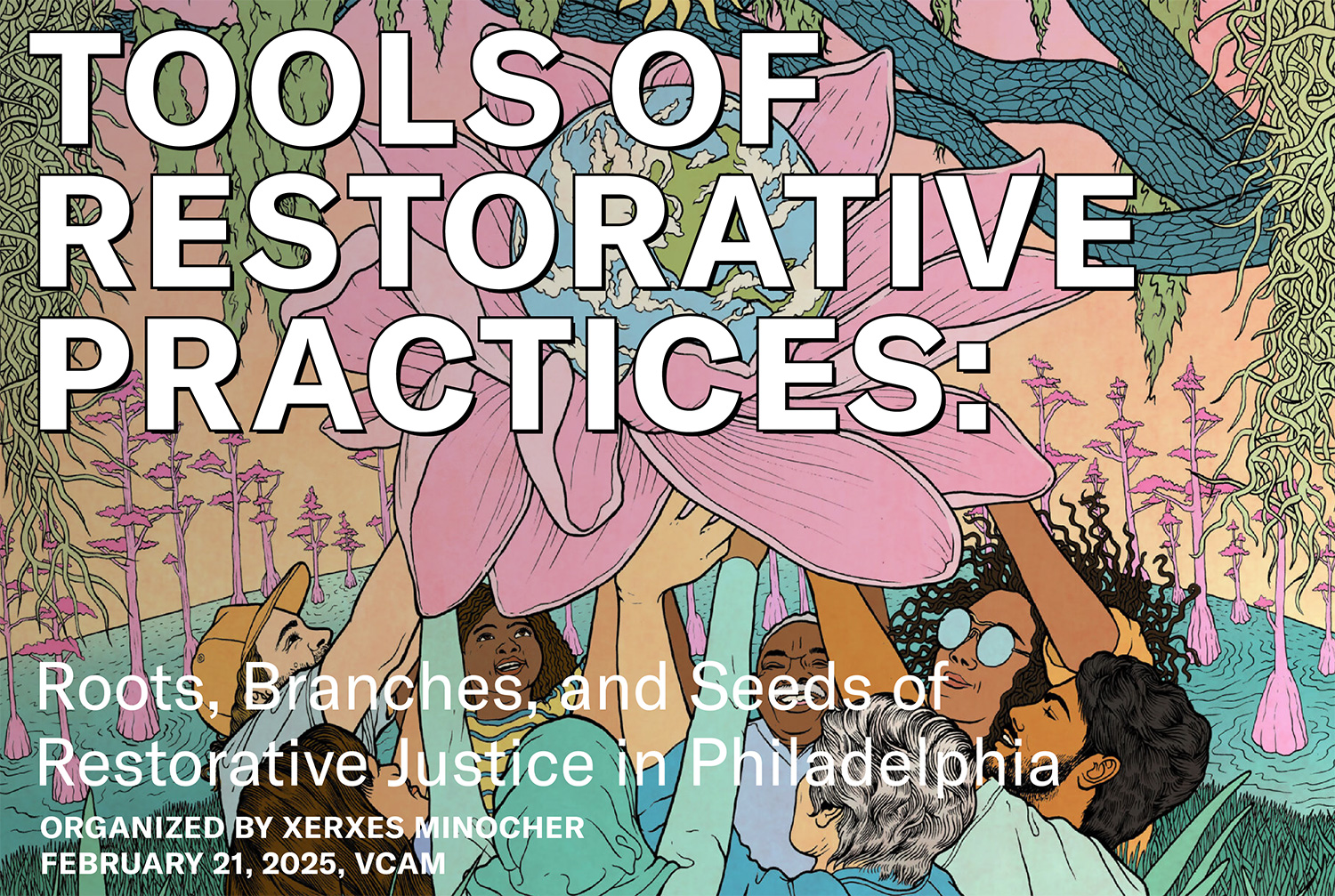
On February 21, 2025, community members across Philadelphia and colleges in the region convened for a day focused on restorative justice. This public symposium was organized during my time as the Mellon Postdoctoral Fellow of Technology and Justice at Haverford College, and was sponsored by the John B. Hurford ’60 Center for the Arts and Humanities. The day featured facilitator speaker panels, workshops for all, and a gallery opening by young artists who had recently completed their own restorative practices.
Centered by Celeste Byers’ powerful image of “Justice First,” the theme of this day was to understand some historic roots, present branches, and future seeds of restorative justice in Philadelphia. As I noted that morning, roots constantly grow as do branches and seeds. That is, restorative practices are dynamic processes, not static enforcements. Understanding the tools of this process, how they can show up in our own lives, and our governance systems, gives us new ideas on how to rebuild, regrow, and renew. In face of the increasing digitalization of the criminal-legal system, understanding our alternatives and enacting them becomes a pressing task. I begin address this task conceptually in tech-washing policing, an article forthcoming in Social Text.
In demands for collective liberation, restorative justice (RJ) often takes on an important position for the kind of worlds we want to build. But many questions remain around what that can look like. Bringing together a range of RJ practitioners across the Philadelphia region, this symposium explores where restorative justice comes from (its roots), how it has been developing in our city (its branches), and what it can look like in the future (its seeds), all in the hopes of clarifying what alternatives are possible. Join us for a day of speakers, panels, workshops, free food, and an art gallery showing to explore and share your and others’ understandings of restorative justice in Philadelphia. Together we can continue building the worlds we want to see, where restoration and transformation are not just imagined, but possible and happening. All are welcome, and feel free to come for portions or the whole day!
Full list of speakers with bios: https://www.haverford.edu/center-arts-and-humanities/events/tools-of-restorative-practices